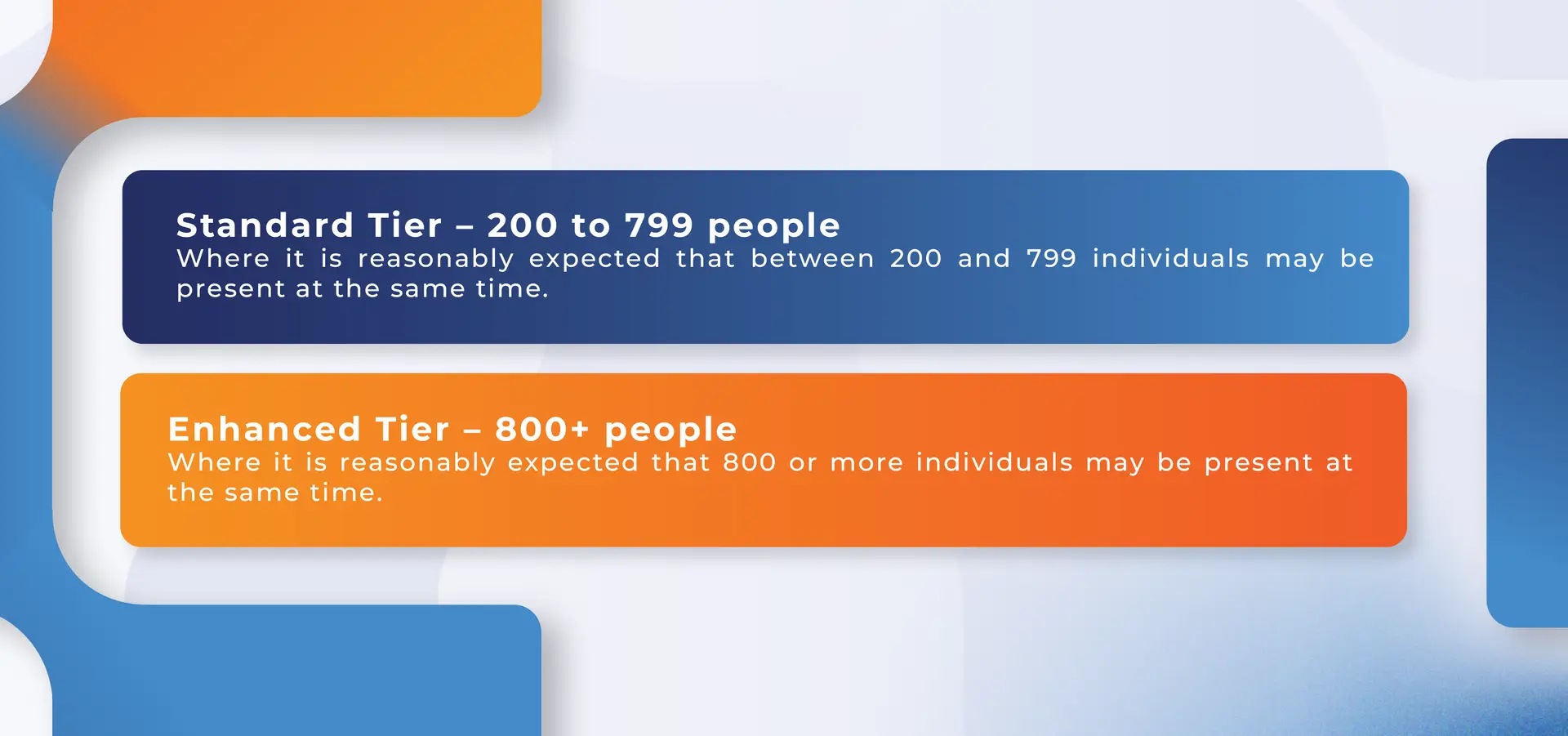
What will standard-tier premises need to do?
For standard-tier premises, Martyn’s Law focuses primarily on preparedness and procedures.
Once the requirements come into force, the responsible person will need to notify the Security Industry Authority (SIA) of the premises and have appropriate public protection procedures in place, so far as reasonably practicable.
Those procedures concern four particularly important areas, also highlighted in Synergy Prestige's original guide: martyns law prestige social
Evacuation - getting people safely out of the premises.
Invacuation - moving people to a safer place within the premises.
Lockdown -securing the premises against an attacker.
Communication - ensuring people on the premises can be alerted to danger and given appropriate information.
These aren't simply documents to have sitting in a folder. Effective procedures need to make sense for the particular premises and for the people expected to implement them.
The Home Office describes the standard-tier requirements as centred around simple, low-cost activities, with costs expected to relate primarily to staff time.
What changes for enhanced-tier premises?
Enhanced-tier premises and qualifying events must meet the core requirements applying to qualifying premises, but the Act goes further.
The responsible person will also be required, so far as reasonably practicable, to put appropriate public protection measures in place that could reasonably be expected to reduce both the premises or event's vulnerability to terrorism and the risk of physical harm should an attack occur there or nearby.
The relevant procedures and measures will also need to be documented and provided to the SIA, including an assessment of how they reduce vulnerability and/or the risk of harm.
Where the responsible person is an organisation rather than an individual, a senior individual must also be designated with responsibility for ensuring that the organisation complies with the relevant requirements.
Who is responsible?
One of the most important questions for businesses is identifying the responsible person.
For qualifying premises, this will generally be the individual, company or organisation that has control of the premises in connection with its relevant use.
For qualifying events, it is the person or organisation controlling the premises in connection with their use for that particular event. This can therefore be different from whoever normally controls the site.
Tasks can be delegated to employees or service providers, but the Home Office makes clear that the responsible person cannot delegate the underlying legal responsibility to a contracted service provider.
When does Martyn’s Law come into force?
The Act is already law, but its substantive requirements are not yet in force.
The Government intends there to be an implementation period of at least 24 months from Royal Assent on 3 April 2025. This period is intended to give organisations time to understand their obligations and prepare, while allowing the SIA's new regulatory function to be established.
The Government published statutory guidance on 15 April 2026 to help responsible persons understand the requirements and how they may be met in practice.
There is currently no legal requirement to comply before commencement. However, the Home Office explicitly notes that organisations likely to fall within scope may wish to start considering the requirements during the implementation period.
What should businesses be doing now?
For organisations operating public-facing premises or events, preparation begins with understanding the basics.
Establish whether your premises or events are likely to fall within scope. Consider the number of people, including staff, that could reasonably be expected to be present at the same time. Identify who would be the responsible person and review the procedures already in place for evacuation, invacuation, lockdown and communication.
For larger premises and events, the conversation also needs to include vulnerability, protective measures, monitoring and how those measures will eventually be documented.
Existing information can be useful when assessing expected occupancy. The Home Office specifically notes that organisations may use methods they already understand, including fire-safety occupancy calculations and historic attendance data.
Preparation, not panic
Martyn’s Law represents an important change for many organisations responsible for publicly accessible premises and events, but preparation should be proportionate to the premises and its circumstances.
It is also important to distinguish legal requirements from commercial services being offered around them. The Home Office specifically states that businesses do not need to spend money on consultants in order to comply, and neither the Home Office nor the SIA endorses third-party products marketed for Martyn’s Law compliance.
For businesses, the sensible starting point is therefore not purchasing a particular product.
It is understanding your responsibilities, reviewing existing arrangements and identifying where genuine gaps exist.
How Synergy Prestige can support your wider security planning
For organisations reviewing their security arrangements ahead of Martyn’s Law, this is also an opportunity to consider how existing people, procedures and physical security measures work together.
Synergy Prestige can support organisations with their wider security requirements and help businesses consider practical security arrangements appropriate to their premises and operations.
The objective should not simply be preparing for legislation. It should be creating an environment in which staff understand what to do, security arrangements are appropriate to the risks, and people using the premises are better protected.
For authoritative information on the legislation and its requirements, businesses should always refer to the official Martyn's Law Factsheet or The Terrorism (Protection of Premises) Act 2025