
April 2026 | Critical National Infrastructure, Security & Resilience
The protection of the UK's Critical National Infrastructure has never been more important.
Energy, transport, communications, water, healthcare, financial services, digital infrastructure & other essential systems underpin everyday life & the functioning of the UK economy.
As these environments become increasingly interconnected & technology-dependent, the risks facing them are also changing.
Cyber incidents, physical security threats, disruption to supply chains, extreme weather, infrastructure failure & geopolitical events can all potentially affect an organisation's ability to maintain essential operations.
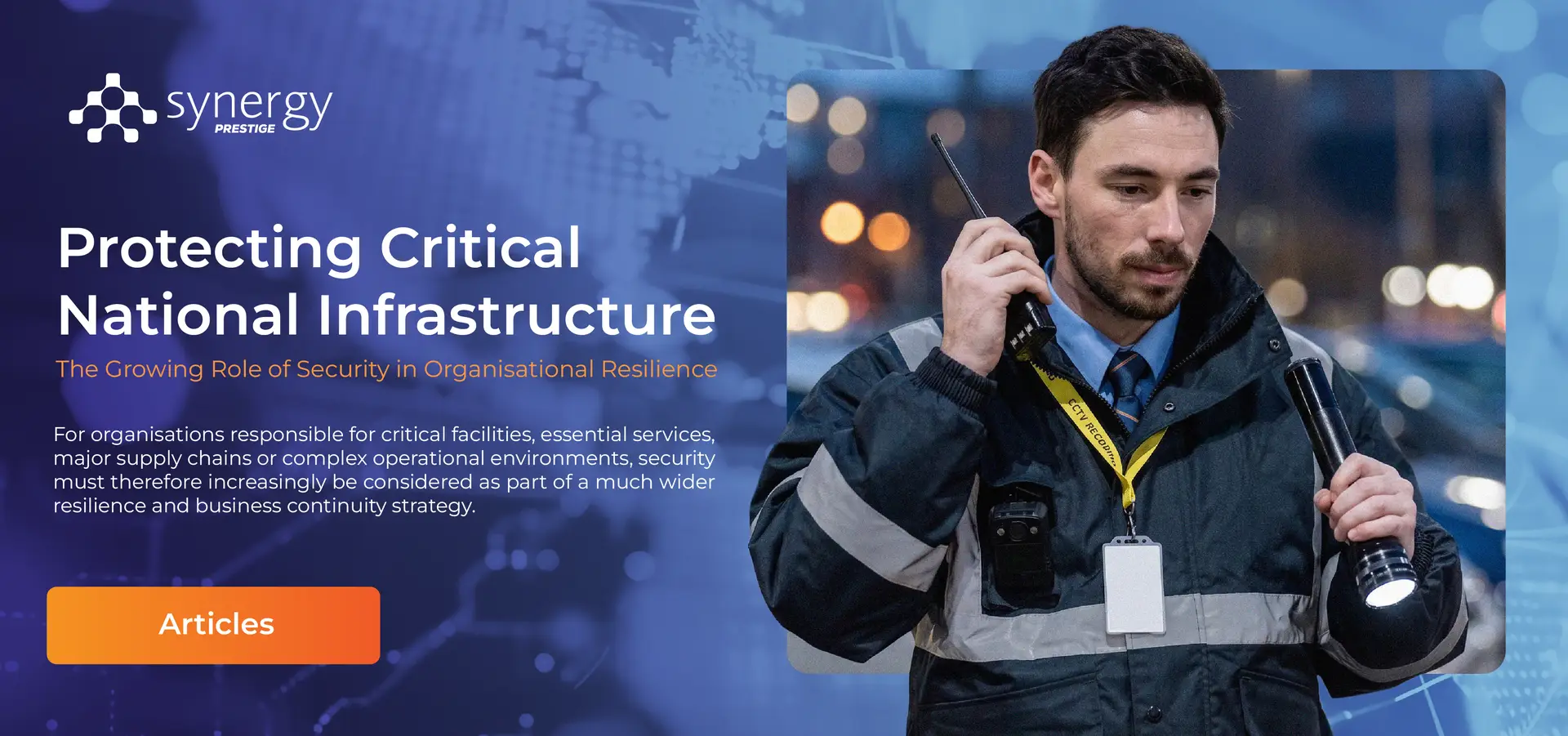
For organisations responsible for critical facilities, essential services, major supply chains or complex operational environments, security must therefore increasingly be considered as part of a much wider resilience and business continuity strategy.
Security Beyond the Building
Traditionally, physical security has often focused on protecting a defined location controlling access, preventing unauthorised entry and protecting people, property & assets.
Today's risk environment requires organisations to think more broadly.
Disruption at one location can have consequences across an entire operation.
Restricted access to a facility can affect employees, suppliers & customers.
An incident affecting transport, communications or energy infrastructure can quickly impact organisations far removed from where the original disruption occurred.
A cyber incident can create operational & physical consequences.
And disruption affecting a critical supplier can quickly move through an interconnected supply chain.
The role of security therefore extends beyond protecting a building.
It is about helping organisations maintain control, protect critical operations and respond effectively when circumstances change.
Preparing for Disruption
Effective resilience starts before an incident occurs.
Organisations need to understand which locations, assets, people, systems & activities are critical to their operations & consider how these would be protected during a significant disruption.
From a physical security perspective, this can include contingency arrangements around:
Security GuardingAdditional or emergency security resources where normal arrangements are disrupted.
Access & Perimeter ManagementMaintaining control of critical facilities during heightened security or unusual operating conditions.
Mobile SecurityProviding additional patrols, property checks & flexible security resources.
Keyholding & Alarm ResponseEnsuring appropriate response capability remains available outside normal operating hours.
Incident ManagementCapturing information quickly and ensuring incidents are appropriately assessed & escalated.
Emergency PreparednessEnsuring people understand what is expected during evacuation, invacuation, lockdown or other emergency situations.
Just as importantly, organisations need clearly established communication & decision-making structures.
When an incident develops quickly, knowing who is responsible, who needs to be informed & what action should be taken can significantly improve the effectiveness of the response.
The UK's Focus on Critical National Infrastructure
The UK has long recognised the importance of protecting its Critical National Infrastructure.
Today, however, the approach to resilience is increasingly holistic.
Protecting critical operations requires organisations to consider the interaction between physical security, personnel security, cyber security, operational technology & organisational resilience.
The National Protective Security Authority provides protective security guidance to organisations across UK Critical National Infrastructure, while the National Cyber Security Centre supports organisations in strengthening their cyber resilience.
The underlying principle is increasingly important:
No single security measure operates in isolation.
A sophisticated access control system is only effective if access permissions are appropriately managed.
CCTV provides limited value if nobody can respond when unusual activity is identified.
Cyber security controls cannot compensate for unrestricted physical access to sensitive systems.
And a detailed emergency plan provides little protection if employees do not understand their responsibilities.
Resilience depends upon these different layers working together.
The Human Layer of Security
People remain one of the most important elements of protective security.
Technology can identify activity.
Systems can generate alerts.
Procedures can define what should happen.
But people are often required to interpret the information, determine whether something is wrong & decide what happens next.
Security Officers can play a particularly important role within this environment.
They observe.
They verify.
They challenge.
They report.
And during an incident, they can provide the human judgement & immediate presence required to support an organisation's response.
For organisations operating critical or complex environments, the effectiveness of frontline personnel therefore depends upon training, awareness, procedures, communication & operational support.
The Role of Technology
Technology provides modern security teams with significantly greater operational visibility than was previously possible.
Real-time workforce management can provide information around deployment & attendance.
GPS-enabled mobile operations can provide visibility of patrol and response resources.
Digital patrol systems can verify that critical areas have been inspected.
Incident management platforms can capture information, photographs & reports when something occurs.
CCTV, access control & other electronic security systems provide further layers of protection & information.
When these systems are appropriately connected with frontline personnel & operational management, they can provide organisations with a much clearer picture of what is happening across their locations.
Technology doesn't replace experienced security professionals.
It gives them better information with which to make better decisions.
Physical + Personnel + Cyber
One of the most important developments in Critical National Infrastructure security is the increasing recognition that physical, personnel & cyber risks need to be considered together.
A physical intrusion may provide access to sensitive technology.
A compromised employee or contractor may circumvent otherwise effective security controls.
A cyber incident may disable systems relied upon by physical security teams.
A communications outage may affect an organisation's ability to coordinate its emergency response.
These are not necessarily separate incidents.
They may be different parts of the same event.
For organisations, this means Security, IT, Cyber, Facilities, Business Continuity & Operational teams need clearly defined mechanisms for communicating & escalating information.
Building Resilience Before It Is Needed
Major incidents rarely occur at a convenient time.
For organisations operating critical facilities and complex environments, the ability to respond effectively cannot be created after disruption has already begun.
Plans need to be developed.
Responsibilities need to be understood.
Resources need to be available.
Procedures need to be tested.
And organisations need security partners capable of adapting when the operating environment changes.
At Synergy Prestige, our approach combines people, technology, risk management and mobile security to help our customers protect their people, assets & operations.
Our role is not simply to provide a security presence.
It is to understand the environment in which our customers operate and ensure our security services can contribute to their wider approach to risk, continuity & resilience.
As the UK's security landscape continues to evolve, our focus remains on helping customers move beyond simply reacting to incidents towards building operations that are genuinely prepared for them.
Security protects what matters. Resilience keeps it operating.
Synergy Prestige
Protecting People. Protecting Business. Supporting Resilience.